
Sorry, but your login has failed. Please recheck your login information and resubmit. If your subscription has expired, renew here.
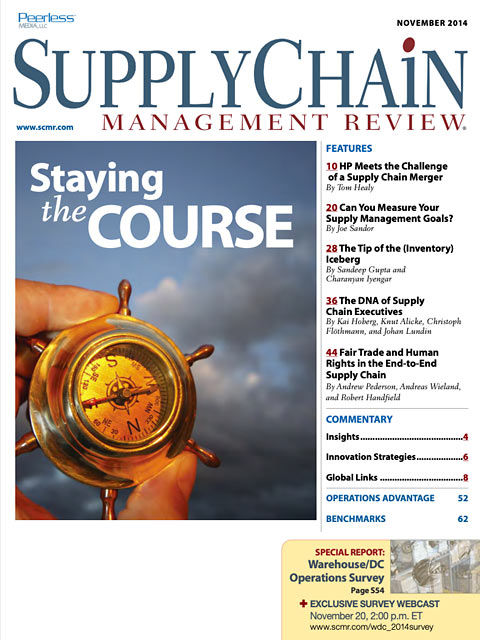
November 2014
Supply chain managers are on the lookout for metrics that will allow them to put a number to their progress - or lack thereof. Welcome to KPI's that allow them to demonstrate the quantifiable value that they deliver. At the same time, Murphy's Law may intervene or they may be called upon to put out fires or come to the rescue and make good on the promises sales and marketing have made to customers - regardless of the cost. So, how do you measure success? I hope this month's issue and online bonus feature help you consider how you measure your progress. Browse this issue archive.Need Help? Contact customer service 1-508-503-1313 More options
As every sailor or fan of the movie “Titanic” knows, it’s not the tip of the iceberg that gets you; the real danger is the ice hidden below the water’s surface. Even though you navigate around the visible ice, the hidden ice can still sink your ship.
High levels of inventory can have the same effect in the retail supply chain. As a Kurt Salmon analysis noted, most retailers carry anywhere between 20 to 40 percent surplus inventory. The reason for this build up, in our experience, is that retail professionals are convinced that if they have inadequate inventory for customers, their businesses are bound to fail. In order to avoid such possibility, the mantra of “keep it filled” conveniently becomes the platform for a second objective of “buy it cheap.”
The failure to manage inventory and contain this surplus becomes the source of what we call hidden costs. These are not the typical costs like inventory carrying costs. Instead, they are costs that do not get associated directly with inventory, but are caused by moving, storing, and handling excess inventory in the enterprise. They affect an organization’s profitability and productivity. What’s more, they could have been avoided by better inventory management.
PASTE Same 3 Paragraphs of text here.
 |
This complete article is available to subscribers
only. Click on Log In Now at the top of this article for full access. Or, Start your PLUS+ subscription for instant access. |
SC
MR
Sorry, but your login has failed. Please recheck your login information and resubmit. If your subscription has expired, renew here.
November 2014
Supply chain managers are on the lookout for metrics that will allow them to put a number to their progress - or lack thereof. Welcome to KPI's that allow them to demonstrate the quantifiable value that they… Browse this issue archive. Access your online digital edition. Download a PDF file of the November 2014 issue.|
|
Download Article PDF |
As every sailor or fan of the movie “Titanic” knows, it’s not the tip of the iceberg that gets you; the real danger is the ice hidden below the water’s surface. Even though you navigate around the visible ice, the hidden ice can still sink your ship.
High levels of inventory can have the same effect in the retail supply chain. As a Kurt Salmon analysis noted, most retailers carry anywhere between 20 to 40 percent surplus inventory. The reason for this build up, in our experience, is that retail professionals are convinced that if they have inadequate inventory for customers, their businesses are bound to fail. In order to avoid such possibility, the mantra of “keep it filled” conveniently becomes the platform for a second objective of “buy it cheap.”
The failure to manage inventory and contain this surplus becomes the source of what we call hidden costs. These are not the typical costs like inventory carrying costs. Instead, they are costs that do not get associated directly with inventory, but are caused by moving, storing, and handling excess inventory in the enterprise. They affect an organization’s profitability and productivity. What’s more, they could have been avoided by better inventory management.
|
|
SUBSCRIBERS: Click here to download PDF of the full article. |
SC
MR

Latest Supply Chain News
- When component verification becomes operational
- Caught between a rock and a hard place: Mapping your supply chain
- What options do you really have? Shaping the supply chain resilience funnel
- Nexus suppliers: Hidden anchors of resilience in decentralized supply chains
- Developing the next generation of supply chain leaders: Is higher education serving the needs of the marketplace?
- More News
Latest Resources
 Explore
Latest Supply Chain News
- Why your supply chain risk management plan will fail
- When component verification becomes operational
- Caught between a rock and a hard place: Mapping your supply chain
- What options do you really have? Shaping the supply chain resilience funnel
- Nexus suppliers: Hidden anchors of resilience in decentralized supply chains
- Developing the next generation of supply chain leaders: Is higher education serving the needs of the marketplace?
- More latest news
Latest Resources
Subscribe

Supply Chain Management Review delivers the best industry content.

Editors’ Picks



